

LOKI
Design, Context and Experience
2023
Overview
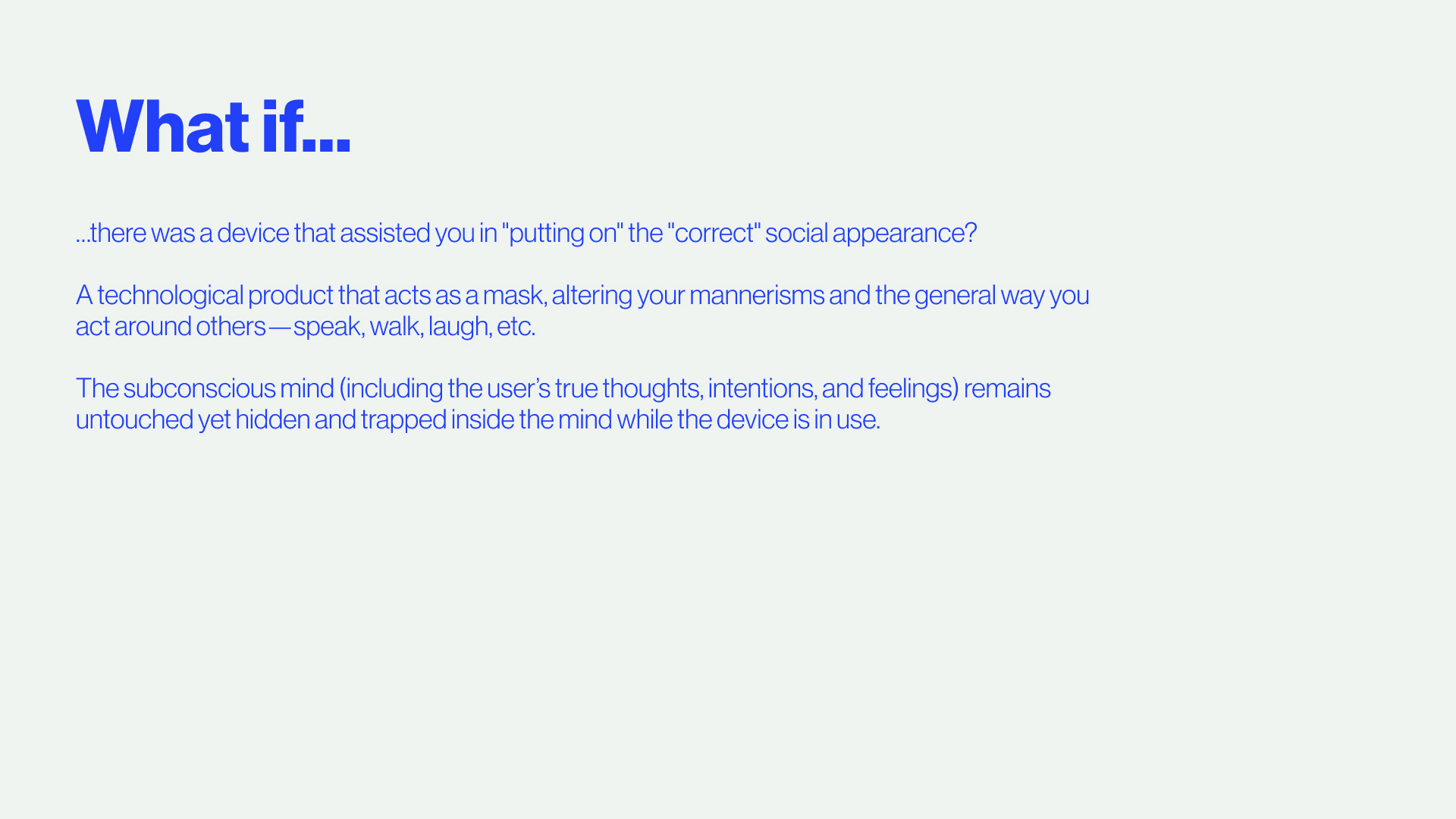
LOKI is a company that does not exist, selling a product that should not. A design fiction, made with Alex and Nick a year or so before the three of us started Torocima.
The premise: a device that assists you in putting on the correct social appearance. It alters your mannerisms and the general way you act around other people, how you speak, walk, laugh. Your subconscious mind is left untouched, but it stays trapped in there while the thing is running.
So the identity had to sell that without ever admitting to it. Everything on the surface is optimistic, clean and confident, the way a tech company talks. Underneath, the mark is a ring with a bar driven through it and a hole punched out of the middle, and the brand calls that bar an equalizer.
The mark
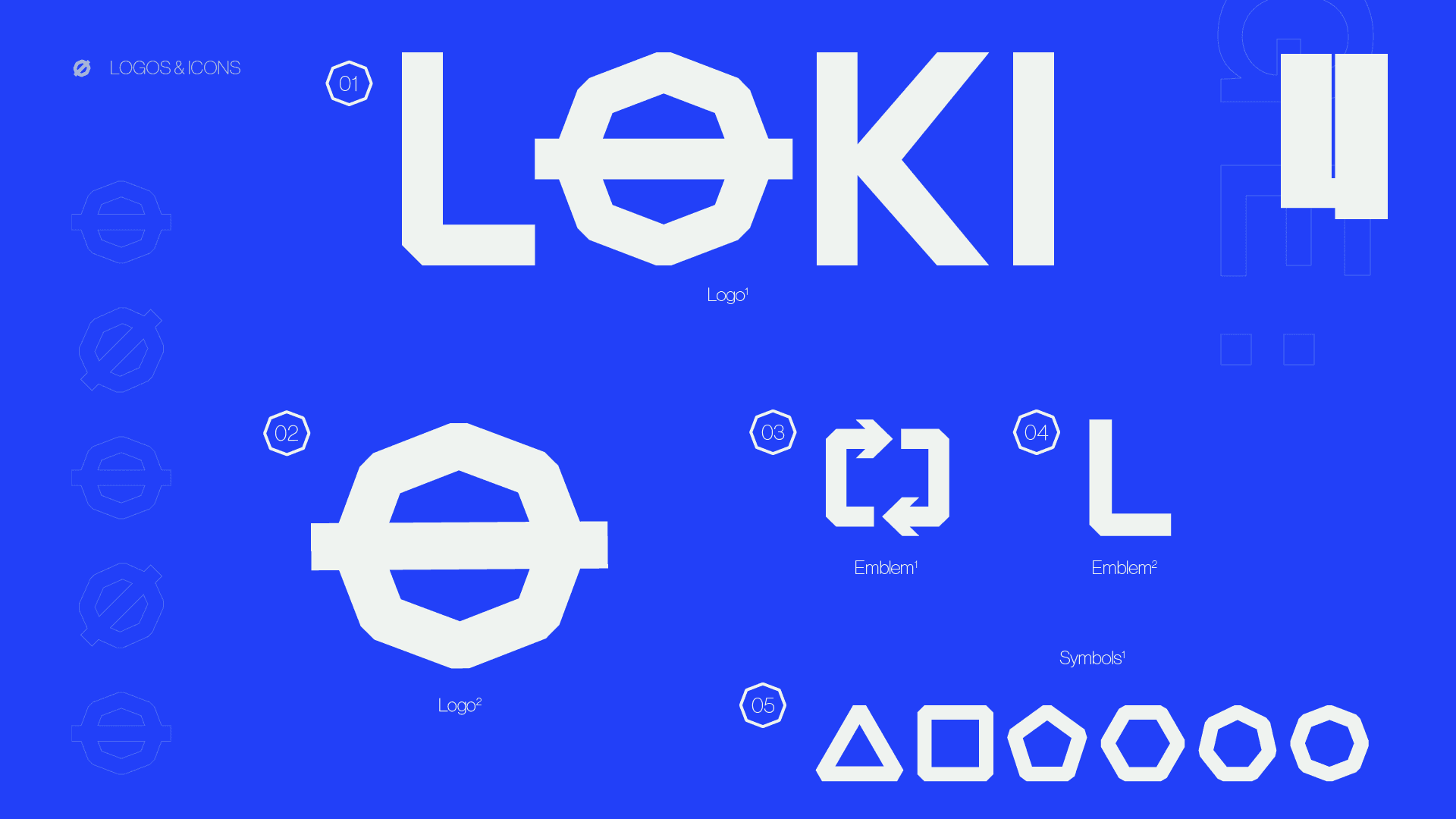
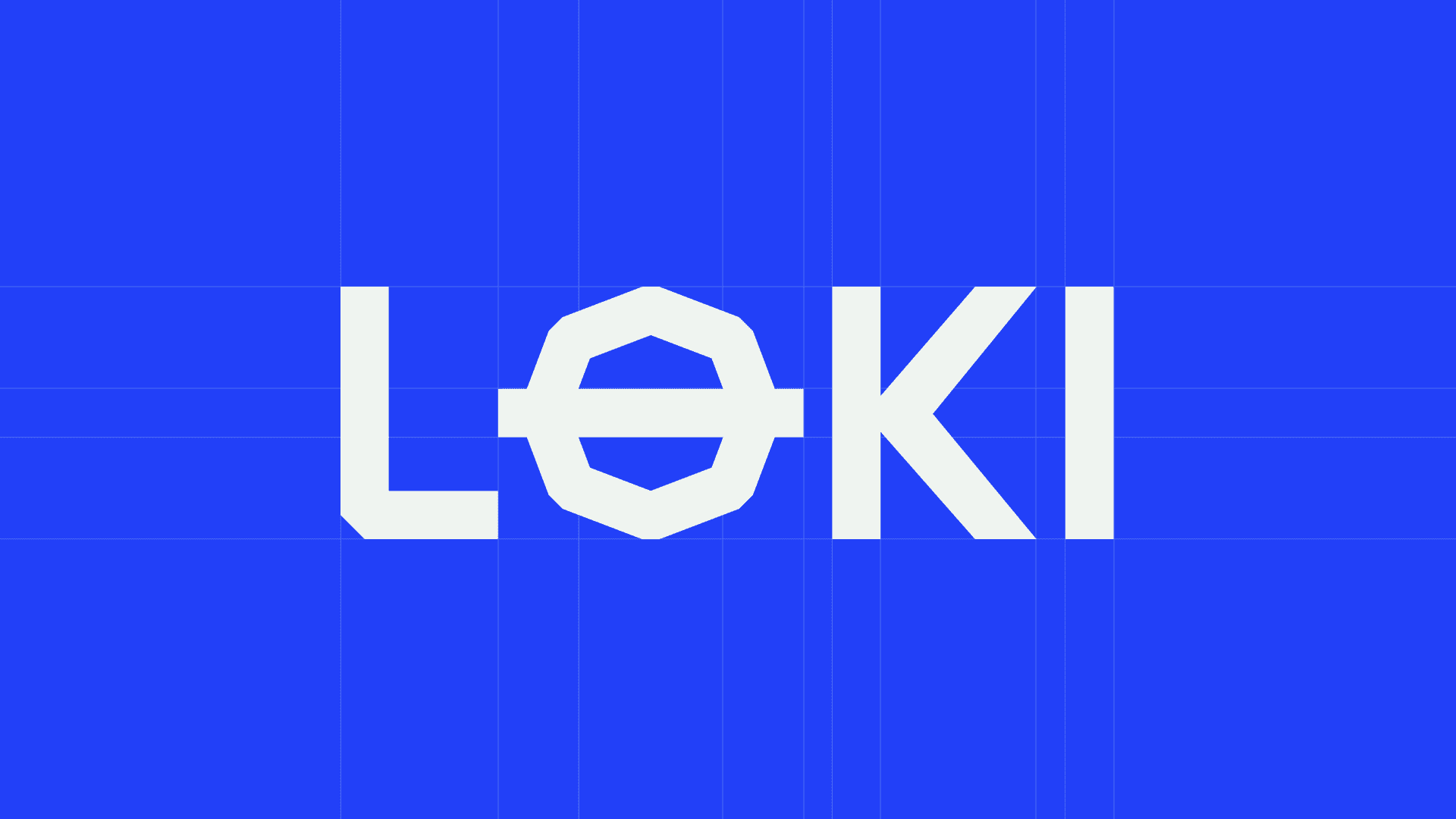
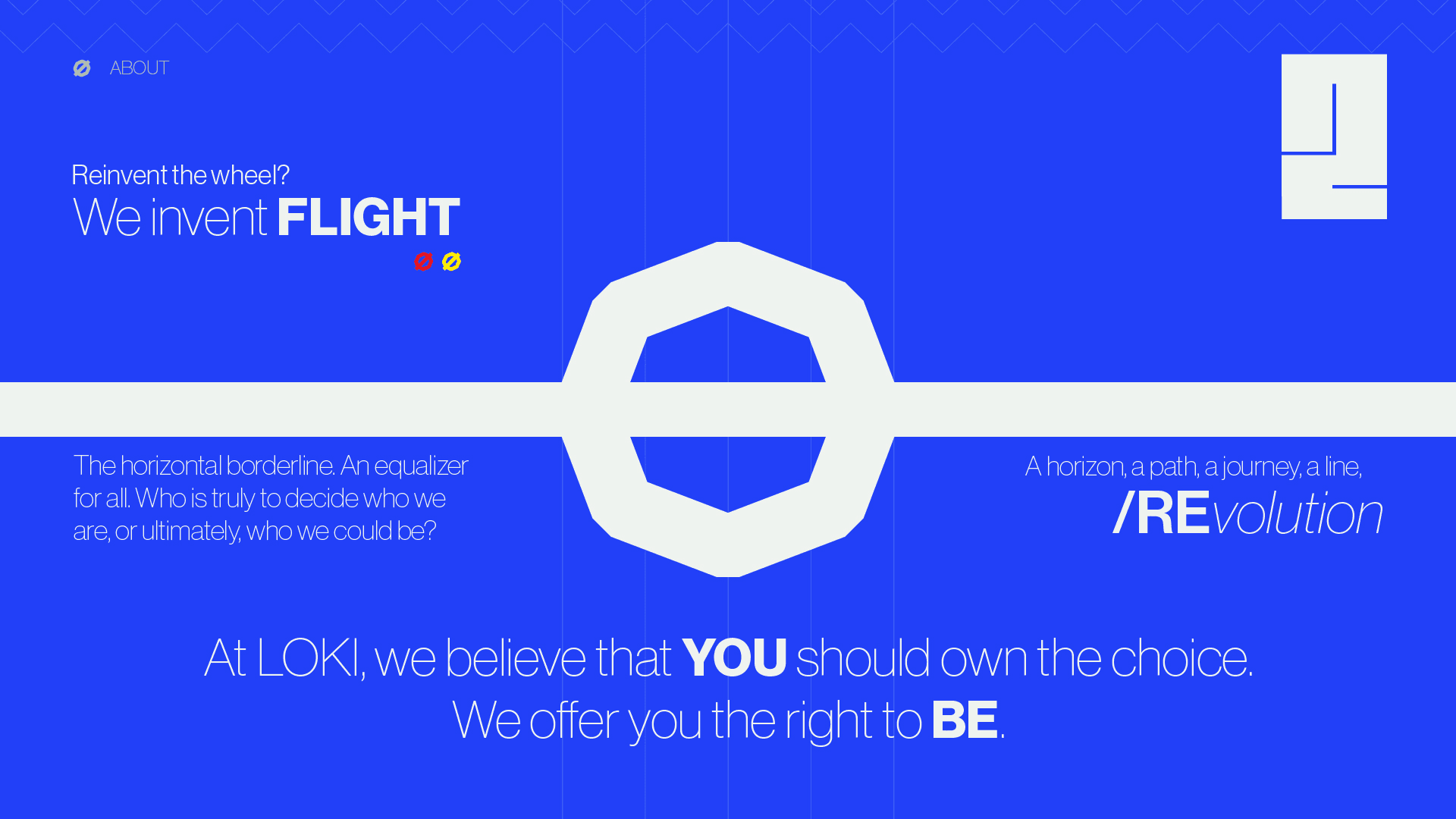
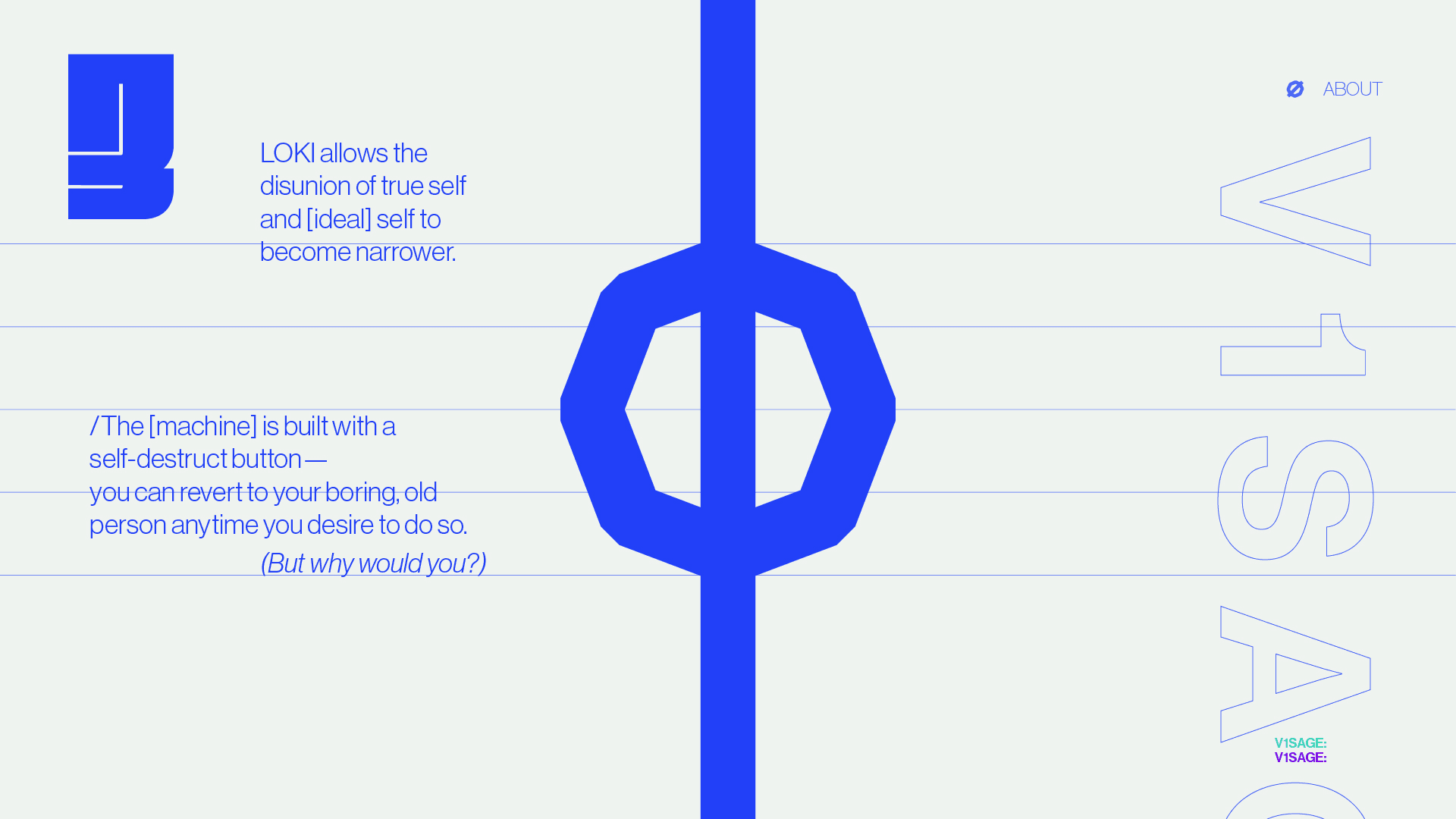
The wordmark's O is the symbol, and the symbol is a valve. It is drawn as a ten-sided ring, cut across the middle by a bar that runs past the ring on both sides, with a heptagon punched out behind it. The brand book reads the bar as a horizon, a path, a journey, a line, and then asks who is truly to decide who we are.
The rule that makes the system work is that assets may only be tilted in equal increments of 45 degrees. Flat, it is the O. At 45 it is the slashed badge stamped in the corner of every page. At 90 it is a vertical bar. Three glyphs, one shape, no redrawing, which is the same trick the hero at the top of this page is doing.
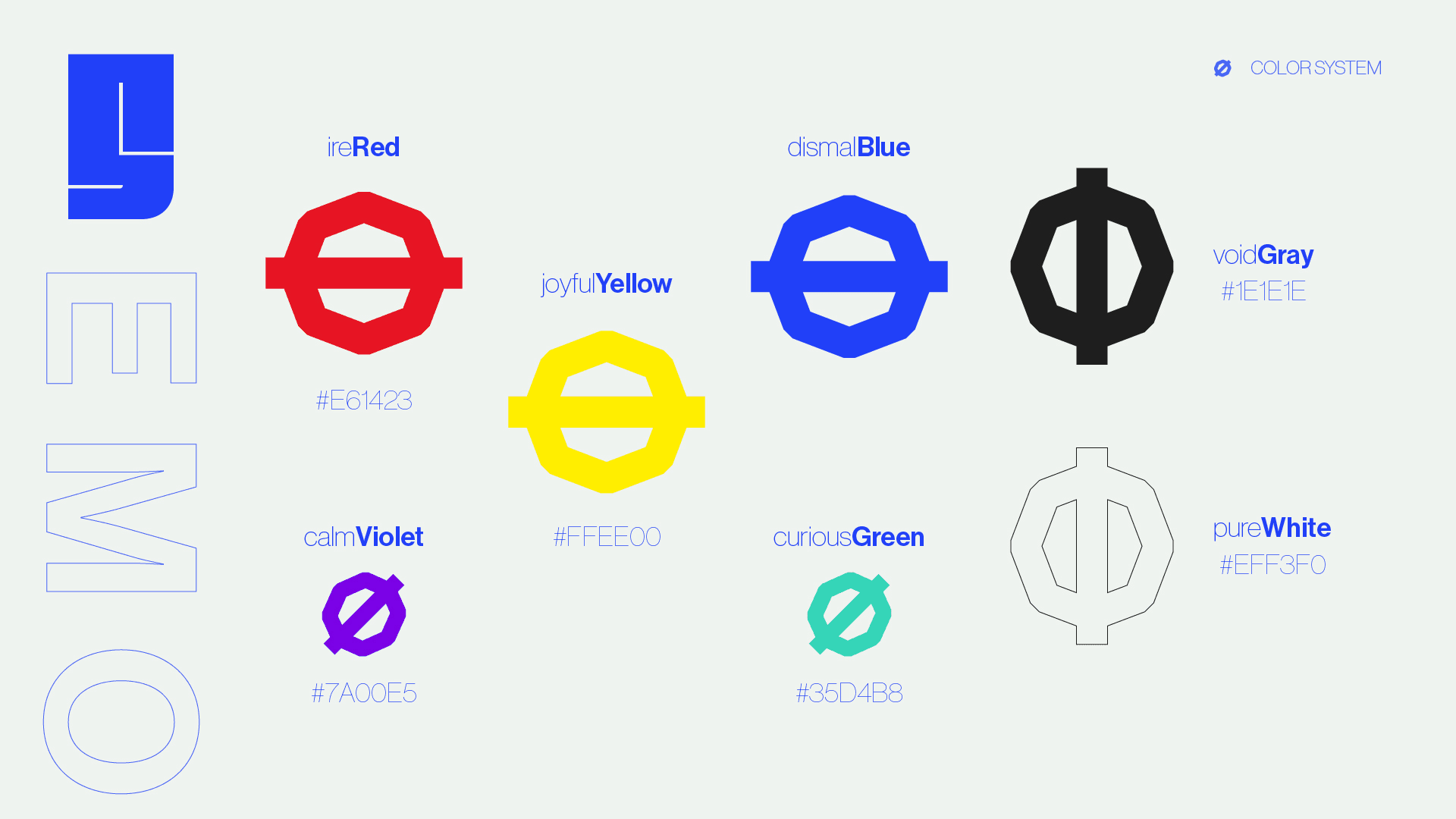
- ireRed#E61423
- joyfulYellow#FFEE00
- dismalBlue#2140F7
- calmViolet#7A00E5
- curiousGreen#35D4B8
- voidGray#1E1E1E
- pureWhite#EFF3F0
What it says out loud
Every claim in the brand book is a claim about freedom, and every one of them is really about compliance. That is the whole trick of the voice, and it is the part I would defend hardest: LOKI never lies to you and never admits to anything either.
The tell is the type size. The promises are set enormous. The terms are set small, in the corner, and phrased as reassurance rather than warning, so the sentence that concedes the product is a cage arrives looking like a customer benefit.
The campaign
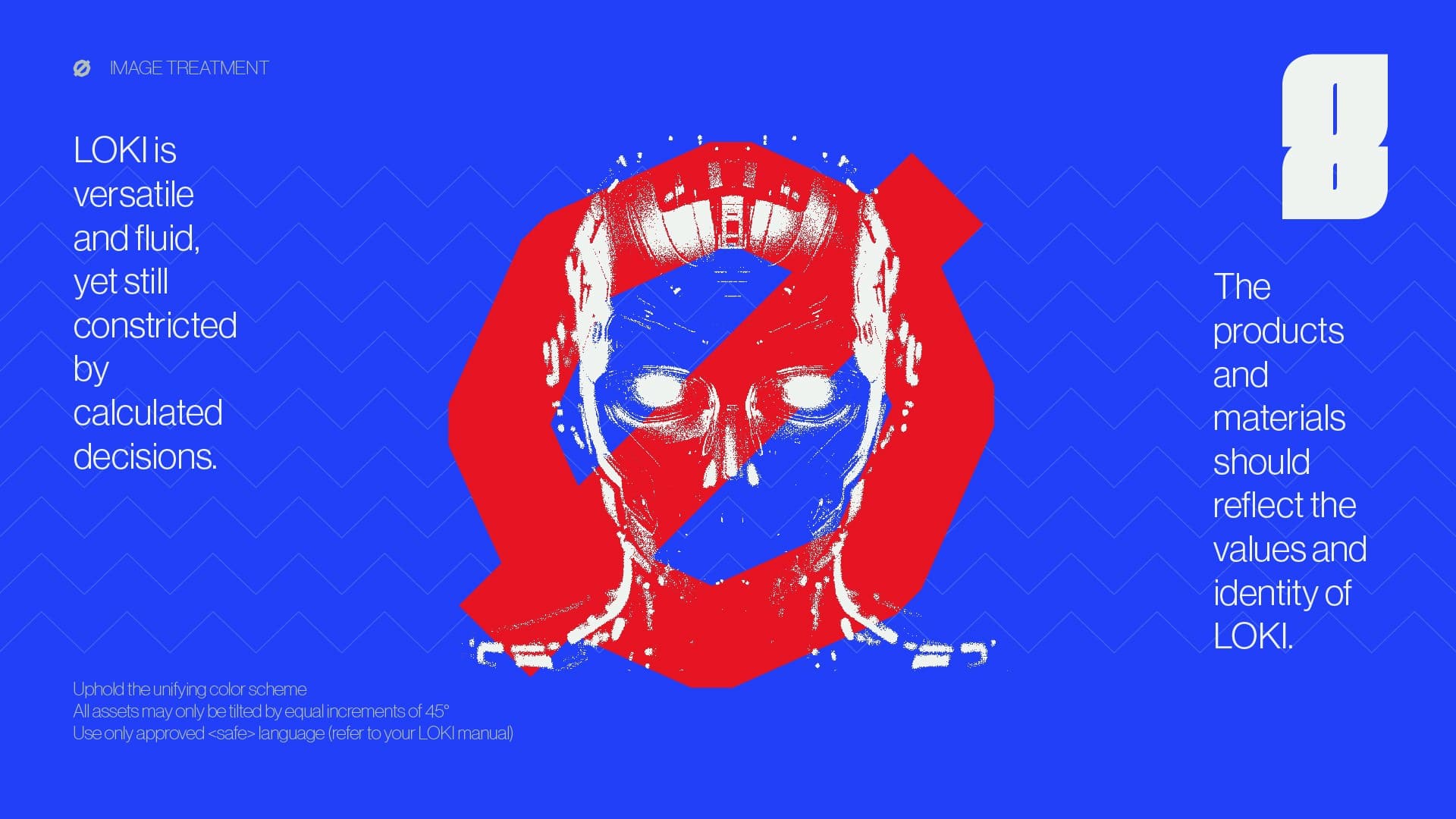
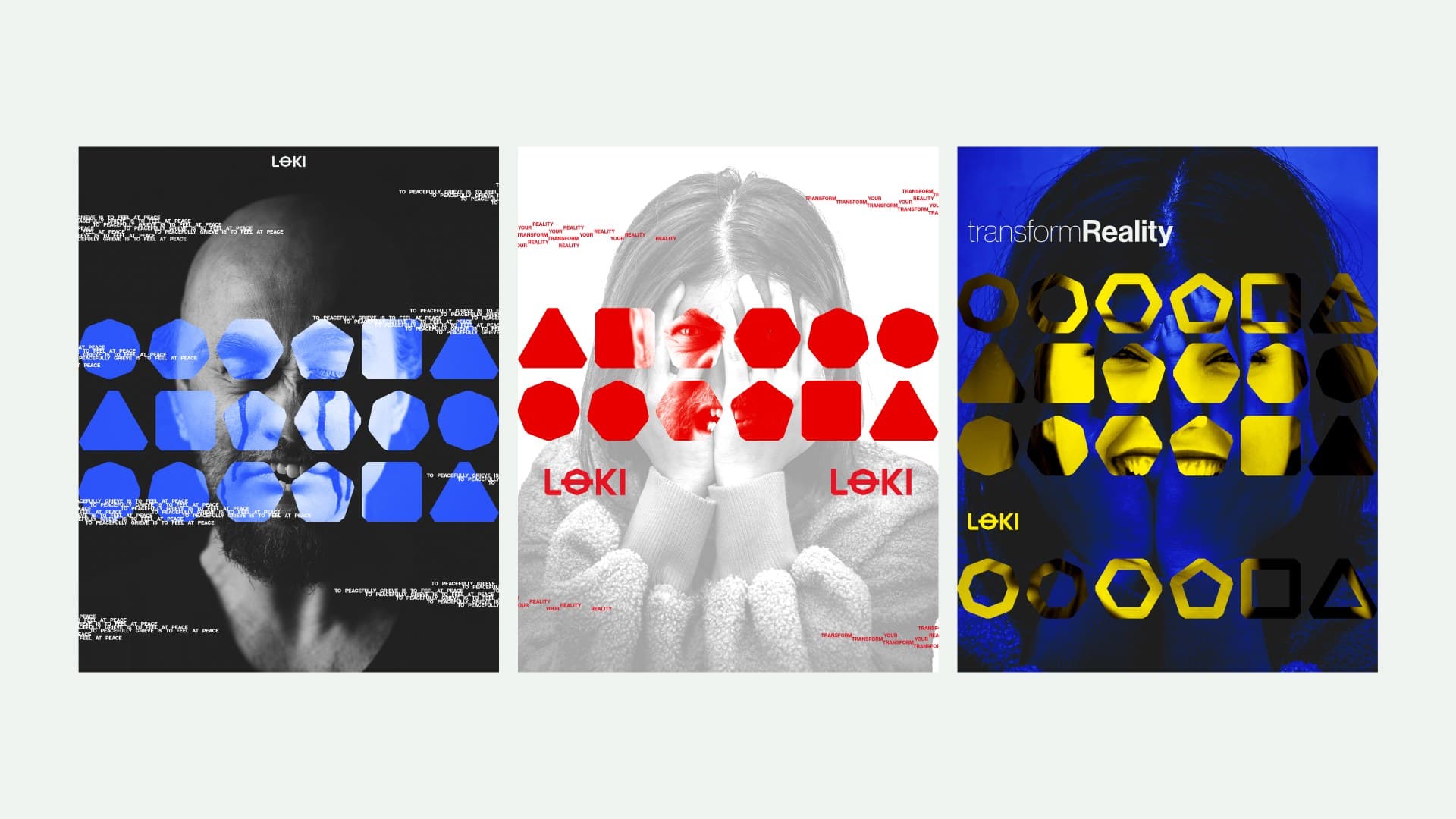
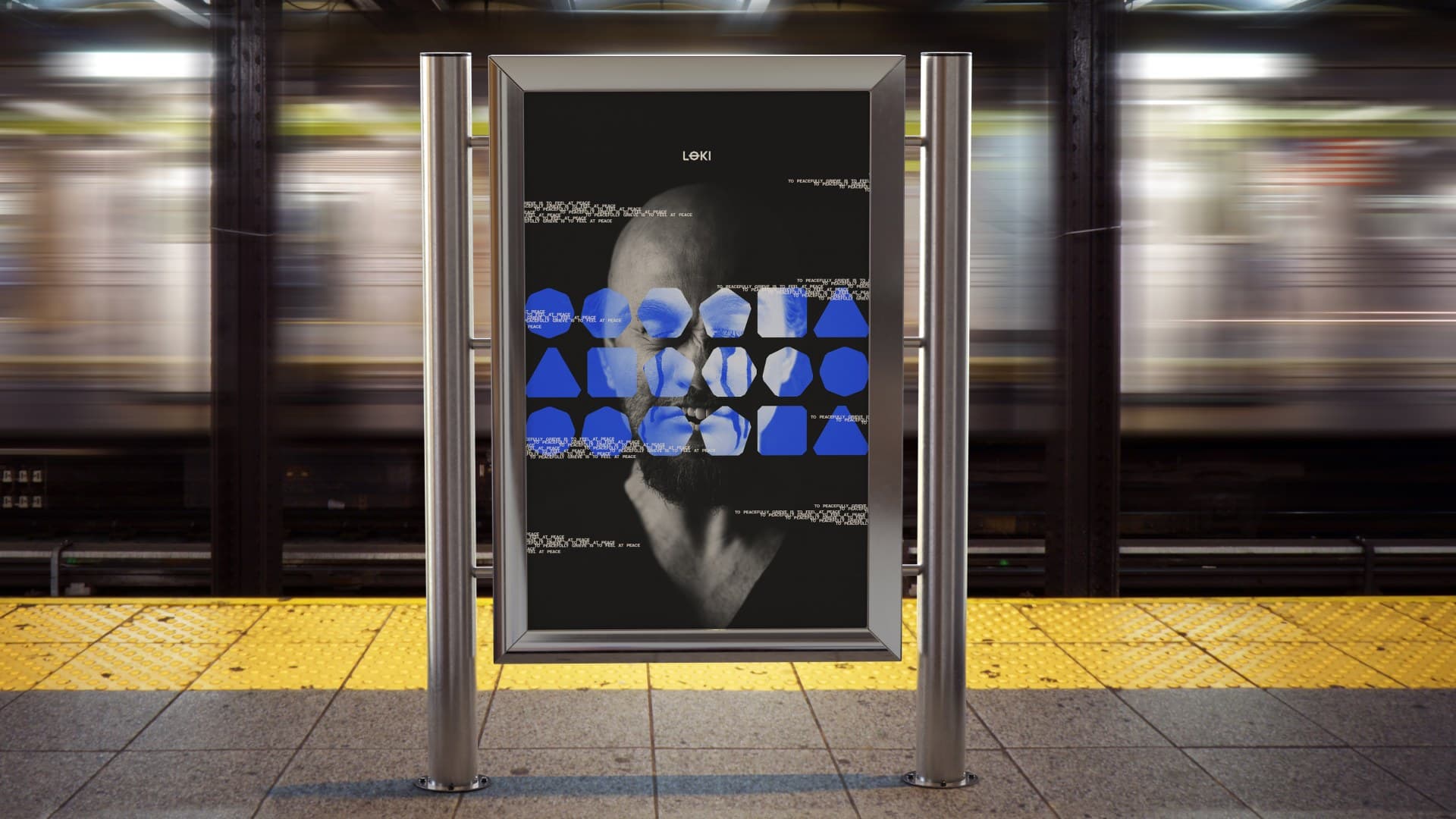
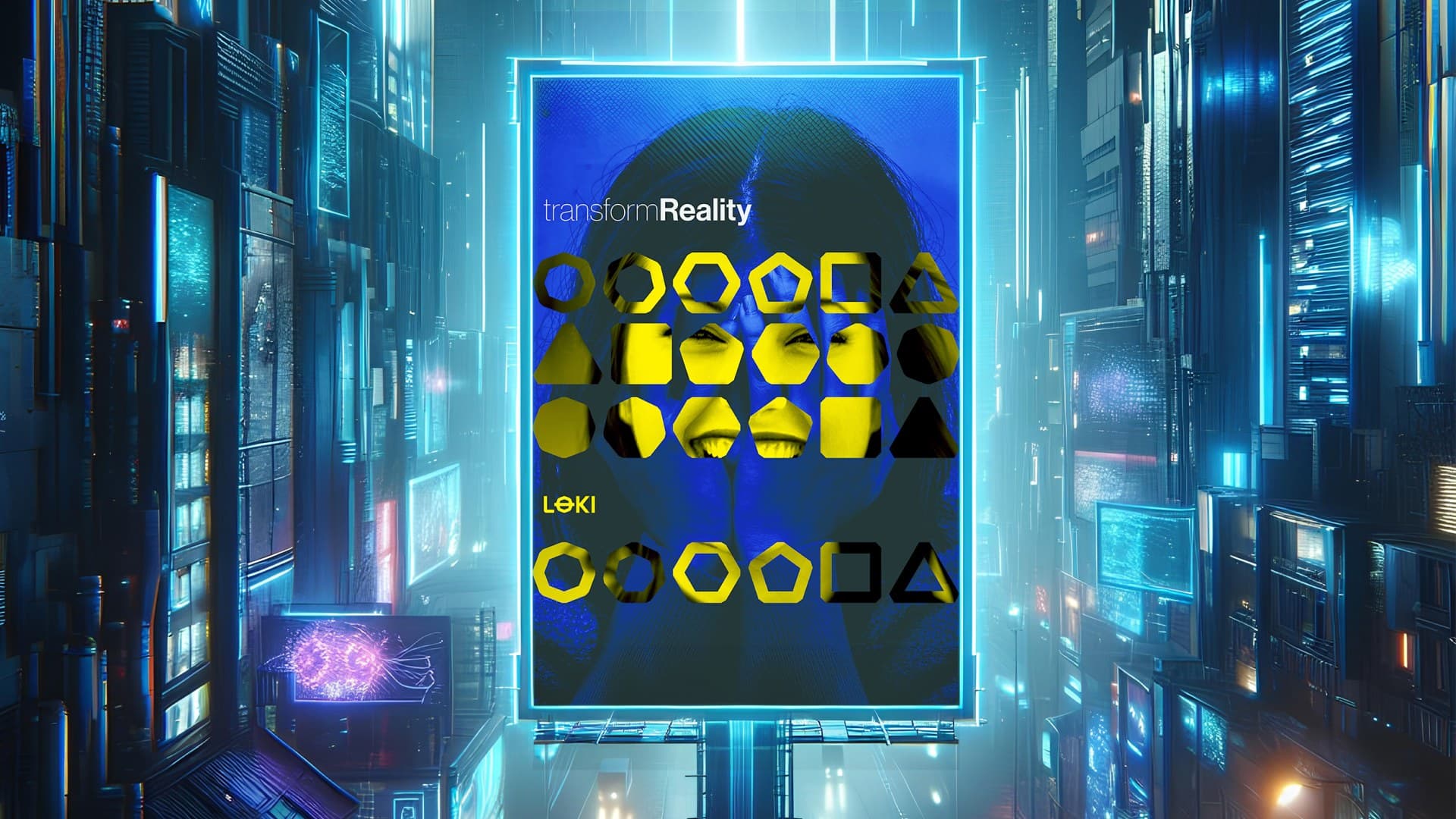
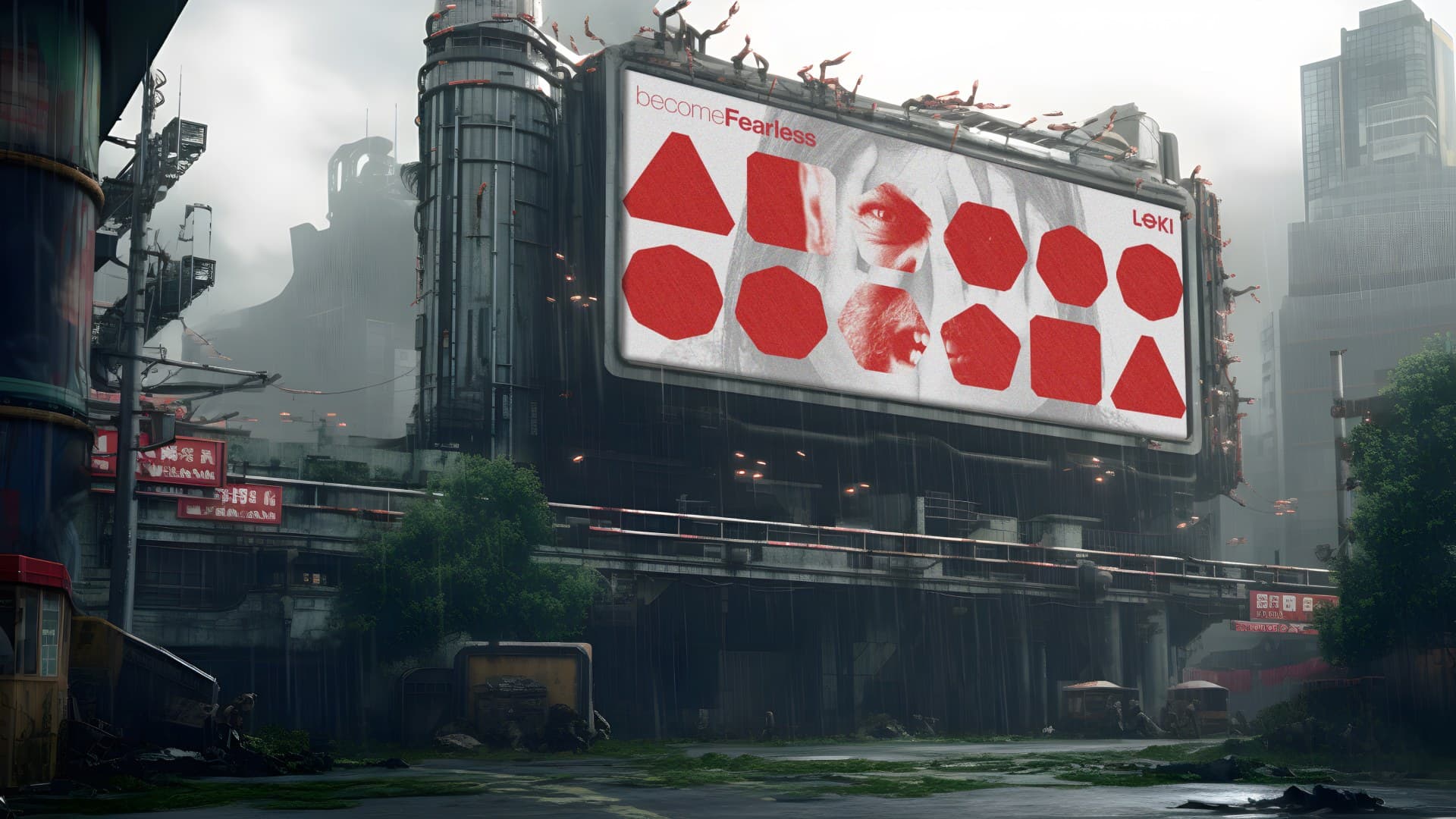
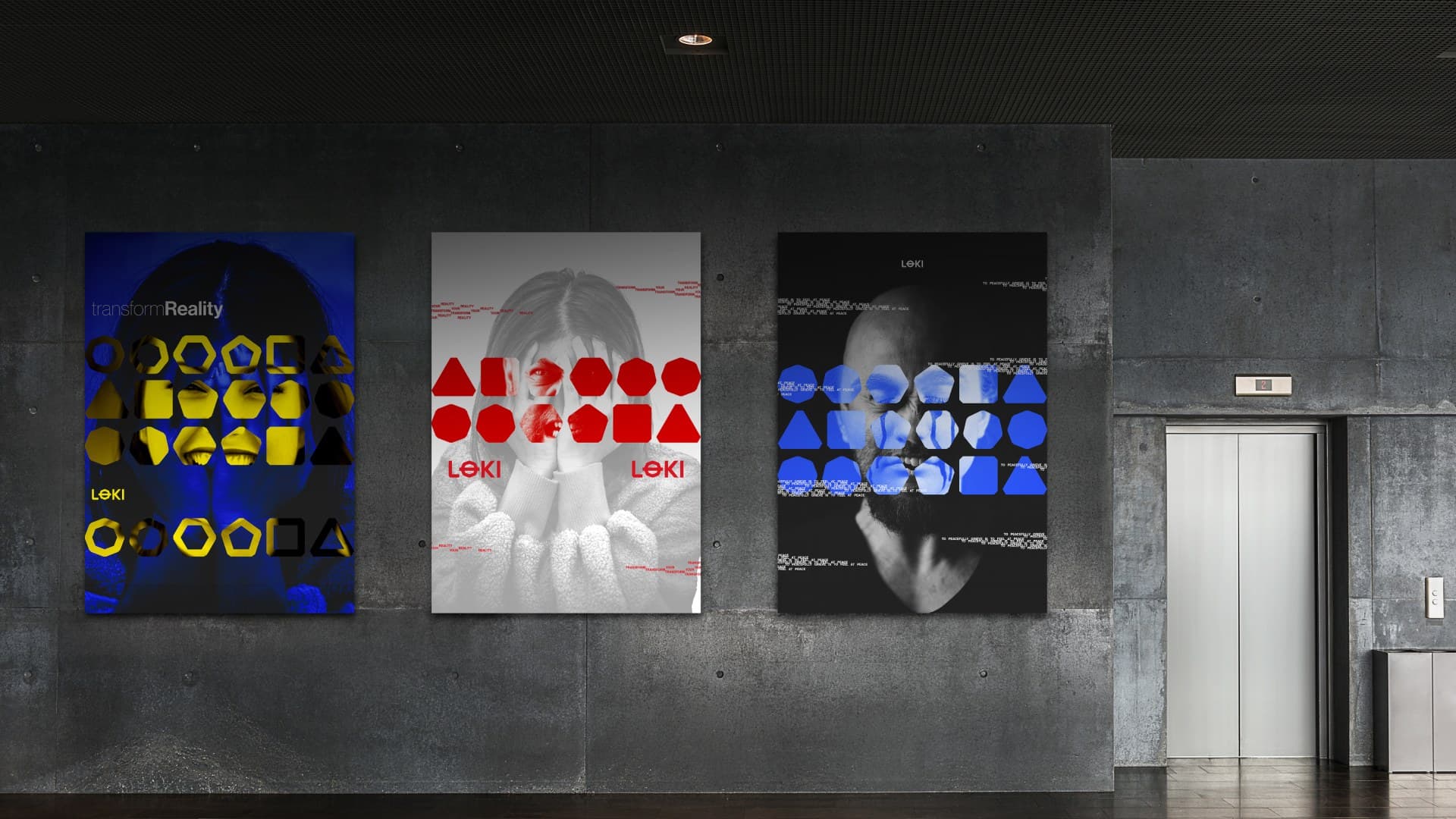
Faces, cut into the brand's own shape set and rebuilt as a grid. Every poster is one person tiled through triangles, squares, pentagons, hexagons and octagons, in two brand colours and nothing else. The line changes per colourway. Become fearless. Transform reality. To peacefully grieve is to feel at peace.
Where it comes from
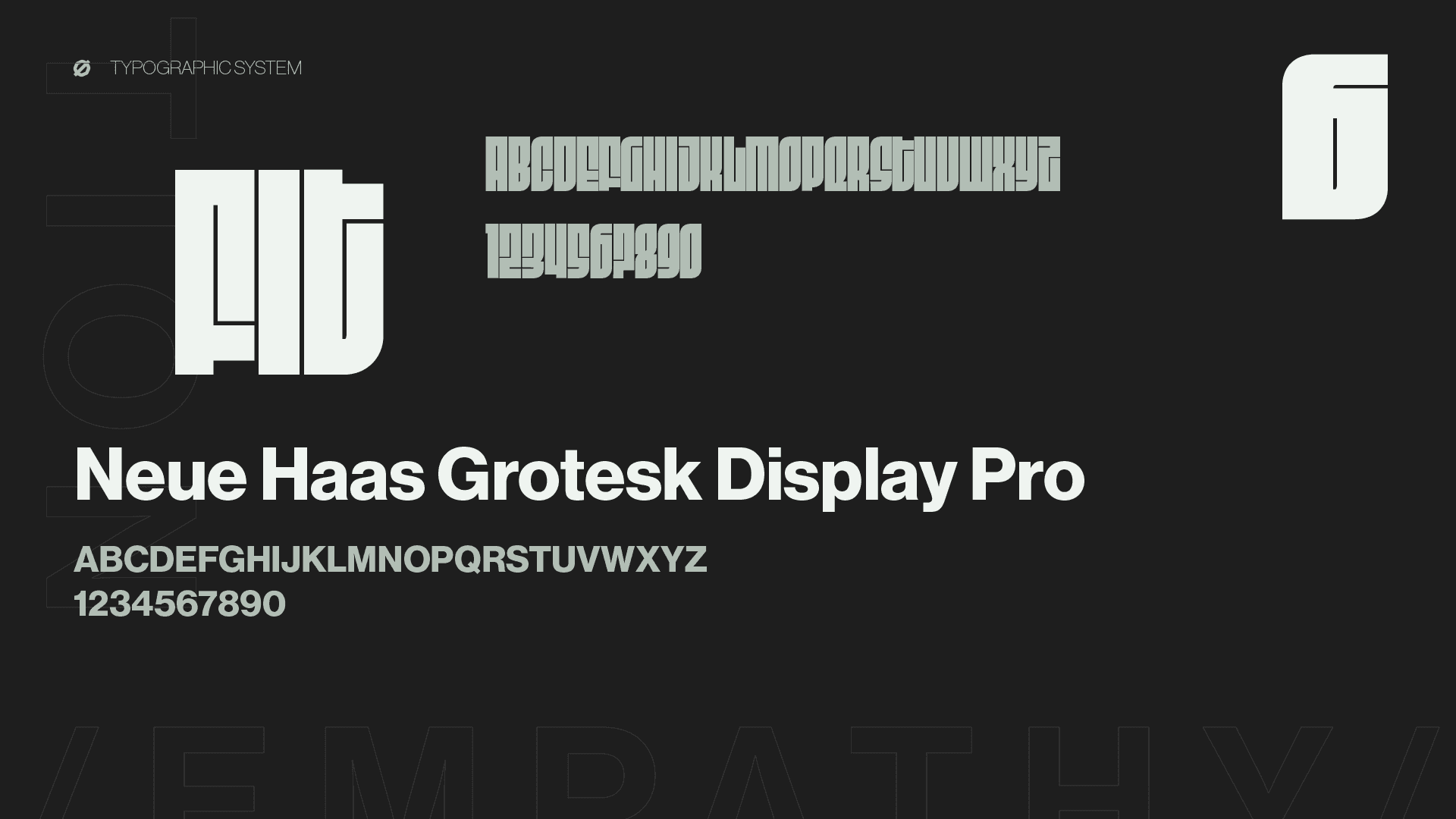
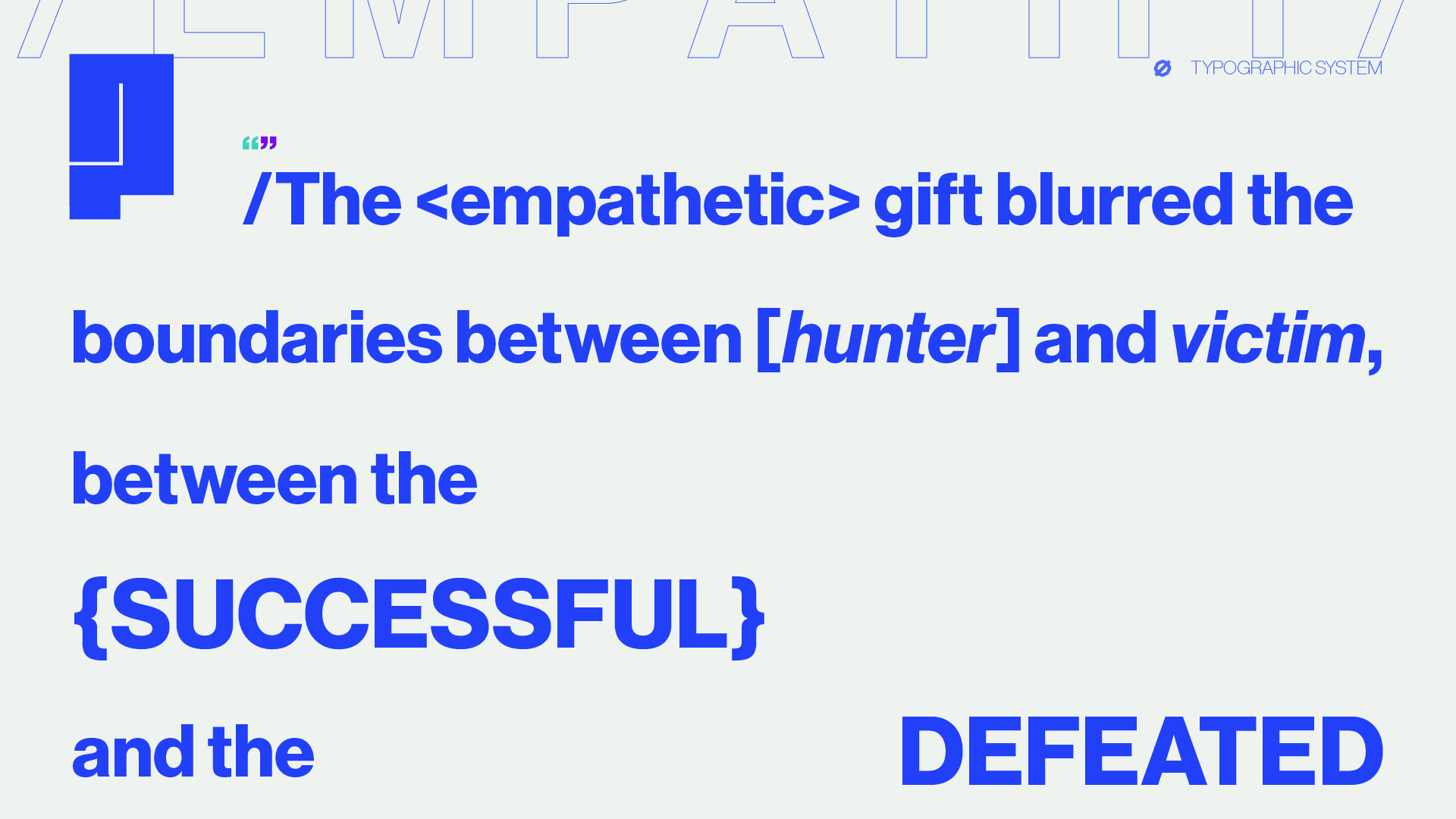
Philip K. Dick's Do Androids Dream of Electric Sheep is one of my favourite books, and it is underneath all of this. The line the typographic system is built around is his, not mine. Setting a novel's warning about empathy as a wall-sized quote in your own brand guidelines is the kind of thing LOKI would do.
The Empathetic Gift
I wrote the world a short story as well as a brand book. LOKI is the company in it, and it never appears by name.
I stare at myself (Him? Us? Them?) in the reflection of a muddied, polluted puddle of water; it is surrounded by a mosaic of cigarette butts—an everlasting relic of the past, as much as humans progressed and regressed; despite our architecture morphing and twisting into anomalous figures; and even after war and calamity, the antiquated yet ever so reliable paper-rolled tobacco triumphed and outlived all (even the countless attempted bans and prohibitions) evident by their stomped corpses decorating the streets—and empty flavor capsules for electronic vapor devices—the bastion of evolution and a spit on the face of technological determinism. The scene appears arranged, perhaps mockingly so, by some cosmic force or being. It has a peculiar harmony, one potent enough to magnetize my attention, that is only disrupted by the centerpiece: a specter inhabiting the opaque liquid peering into this realm. Phantoms in the other dimension mimic the people walking around me, dissipating at the edges of the portal as they get further away. There are no faces in his world of silhouettes, none that I can discern. It brings me an ephemeral peace. I wonder if he feels. He smiles in response to our thoughts.
I end the ritual and rejoin the flow of expressions marching outside of the embellished puddle. When one exits the stream to arrive at their destination, they pause momentarily by the entrance, reach into the depths of their coat pockets or bags with subtle desperation, and pull out their portable syringe. Once loaded, they aim it at their neck like the models in the virtual billboards, press the button, and enter their respective doorways. I hasten my pace with each hissing sound that is released by the syringes, weaving through the vacant entities. One man follows particularly close behind me, trailing and matching my tempo with every increment. He wears (if one could even call it wearing in his state) a suit, unbuttoned with a dotted red tie loosely coiled around his neck. His tattered, white button-up shirt looked like it had been clawed out of his pants, and the deluge of sweat made it appear translucent. His eyes look shattered—if you probed into them, you might witness a fragment of a memory trapped behind his dilated pupils, a hug from his mother, or his first steps. I shoot glances back at him, meeting gazes for decimals of a second. What did he see in my (His? Our? Their?) eyes? We were heading to the same place, following iridescent advertisements that enticed us with the possibility of temporary rebirth—another boost. We allow the disunion of true self and ideal character to become narrower; the words on a fluorescent blue screen bewitch me. We need it.
I arrive at our destination, the emporium for captivated souls. Displays of titanium capsules with abstract symbols and vague names, forged with artificial synapses and previously dead gilal cells, float in glass shelves. Uniformed men wearing bulky virtual frames, tapping aimlessly at thin air, paced with imprinted smiles. One greets me when I walk in, but I wave him off and tell him I know what I want before I can catch my reflection in his goggles—I can't remember my first kiss. Red Tie does the same with a belligerent grunt and a middle finger rather than words. Options with titles like Be Cool sat next to others with pictures of celebrities and fictional characters. The failure of a virtual oasis left us no choice but to manifest as avatars in the corporeal experience. Red Tie is already at the front counter, inserting his left wrist into the reader for payment and using his right to wipe the sweat off his forehead. The worker hands him his capsule with the same static smile, which Red Tie snatches and fumbles into his needle. It is the desperation of a wild animal. Hiss, then steam.
"Feeling new?" asks the man at the counter, closing his eyes and tilting his head like an animatronic. Red Tie kneels down, picks up his suitcase from the floor, and tucks his shirt with an eerie elegance. His steps are meticulous as he approaches the door, as if calculating the distribution of body weight with each one. He pauses in front of me, and I realize I am blocking his exit. He looks taller and somewhat paler up close. He readjusts his necktie, tightening it with a pompous attitude. We share a glance, a lengthy one this time. We could never be more than strangers. Does he see me? I wonder if he sees me, sleeping beyond the surface of my iris. I squint. He nods. I step aside, and he leaves.